Building Alert Pro – All current building applications in your area at a glance
Discover building applications now


The Swiss National Bank (SNB) is leaving the SNB policy rate unchanged once again. It has therefore stood at 0.0 percent for exactly one year – since June 2025. This means for the fourth time in a row that hardly anything has changed in the SNB’s assessment of the international political and economic situation.
The announcement of the policy rate applicable for the next three months took place on 18 June, just one day after the interest rate decision of the US Federal Reserve. It left the target range for the policy rate unchanged at 3.5 to 3.75 percent.
In his inflation forecast for Switzerland, Martin Schlegel, Chairman of the SNB, said: “Inflation has risen as expected since the last monetary policy assessment, from 0.1 percent in February to 0.6 percent in May. This increase was mainly due to higher prices for petroleum products. The other goods and services contributed little to the rise in inflation.” Compared with the last monetary policy assessment, the SNB’s forecast is therefore slightly higher in the shorter term. This is due to higher commodity prices and higher inflation abroad. “In the medium term, the inflation forecast is practically unchanged. The forecast is within the range of price stability over the entire forecast horizon.”
One of the SNB’s top objectives as Switzerland’s central bank is to ensure price stability in the country. Its monetary policy pursues the goal of preserving the value of money for people and companies in Switzerland and supporting the domestic economy.
Only a week earlier, on 11 June, the European Central Bank raised its current policy rate by 25 basis points to 2.25 percent. This came after the policy rate had previously remained unchanged at 2.0 percent in the last seven announcements. Experts had expected the European Central Bank to take this step because, above all, the sharp rise in oil prices as a result of the Iran war had caused prices in the eurozone to rise sharply. By raising the policy rate, the ECB wants to stabilise the euro and counteract high inflation of more than 2 percent. In May, consumer prices in the eurozone rose by 3.2 percent compared with the same month of the previous year.
In Switzerland, by contrast, inflation in May, as in April, stood at 0.6 percent compared with the previous month and therefore remained within the SNB’s target range. The SNB defines price stability as an increase in the Swiss consumer price index of less than 2 percent per year. Martin Schlegel says: “Inflation is likely to rise slightly in the next few quarters, but then fall back again somewhat. Medium-term inflationary pressure has hardly changed. Our conditional inflation forecast is practically unchanged in the medium term compared with March. It is within the range of price stability over the entire forecast horizon. We have therefore decided to leave the SNB policy rate unchanged. Our monetary policy remains expansionary.”
The markets had expected the zero-interest-rate decision. Low interest rates are intended to continue supporting the economy. Price pressure remains low, and the risk of inflation is low. Raiffeisen, for example, assessed the situation in its interest rate forecasts of June 2026 as follows: “The Swiss economy is considerably less energy-sensitive by comparison [than that of the eurozone]. Price pressure remains low. The Swiss National Bank (SNB) is therefore hardly worried about inflation, but more about global demand and a possible appreciation of the franc … Expectations of ECB interest rate hikes have, however, reduced the upward pressure on the franc. There is therefore currently no need for foreign exchange purchases and even less for negative interest rates.”
Graubündner Kantonalbank, for its part, stated on 1 June: “Should the Strait of Hormuz remain blocked, energy prices could indeed rise further and possibly trigger second-round effects; so far, however, there are no signs of such a development. Looking back, average inflation between April 2025 and March 2026 was only 0.1 percent. Average inflation for 2026 and 2027 is estimated at 0.6 percent, which remains in the lower half of the SNB’s target range of 0 to 2 percent. The SNB is therefore likely to view the recent increase more as a welcome normalisation from very low inflation levels than as the beginning of a lasting inflation phase.”
Reuters financial experts also agreed with this assessment. After the ECB raised its policy rate, Reuters reported on 11 June that the Swiss National Bank already had the lowest policy rate in the G10 area. “Markets expect it to keep this at its meeting next week and for the rest of the year, as inflation is subdued and the strong franc is already doing much of the monetary tightening.” The SNB’s decision-makers remain sceptical about returning to negative interest rates, they concluded. “The SNB is likely to rely more heavily on currency interventions to curb the strength of the franc.”
The Zürcher Kantonalbank also agreed with this assessment in its blog post of 19 May entitled “SNB: Politik der ruhigen Hand”. It states: “There is no doubt that these [geopolitical] turbulences have negative effects on the global economy. Switzerland, as a small open economy, cannot escape them. But as with inflation, the Swiss economy experiences global ups and downs in a muted way. We therefore expect below-average, but still respectable economic growth of 1.3 percent for this year. All of this suggests that the Swiss National Bank (SNB) is in a comfortable position in that it does not have to respond immediately to the effects of the Iran war with interest rate policy. It is primarily prepared to intervene in the foreign exchange market in order to cushion a rapid and excessive appreciation of the franc.”
Martin Schlegel confirmed these forecasts at the SNB media conference: “As a result of higher energy prices, inflation has risen in recent months. Medium-term inflationary pressure is, however, practically unchanged compared with the last monetary policy assessment. Our monetary policy is appropriate to keep inflation within the range of price stability, and it supports economic development. We will continue to monitor the situation and adjust monetary policy if necessary in order to ensure price stability.”
The zero-interest-rate policy supports the export-oriented economy by keeping the purchase of Swiss goods attractive for foreign companies. Imported goods and services, on the other hand, can tend to become more expensive with a weaker franc, for example fashion items, electronic devices or travel abroad.
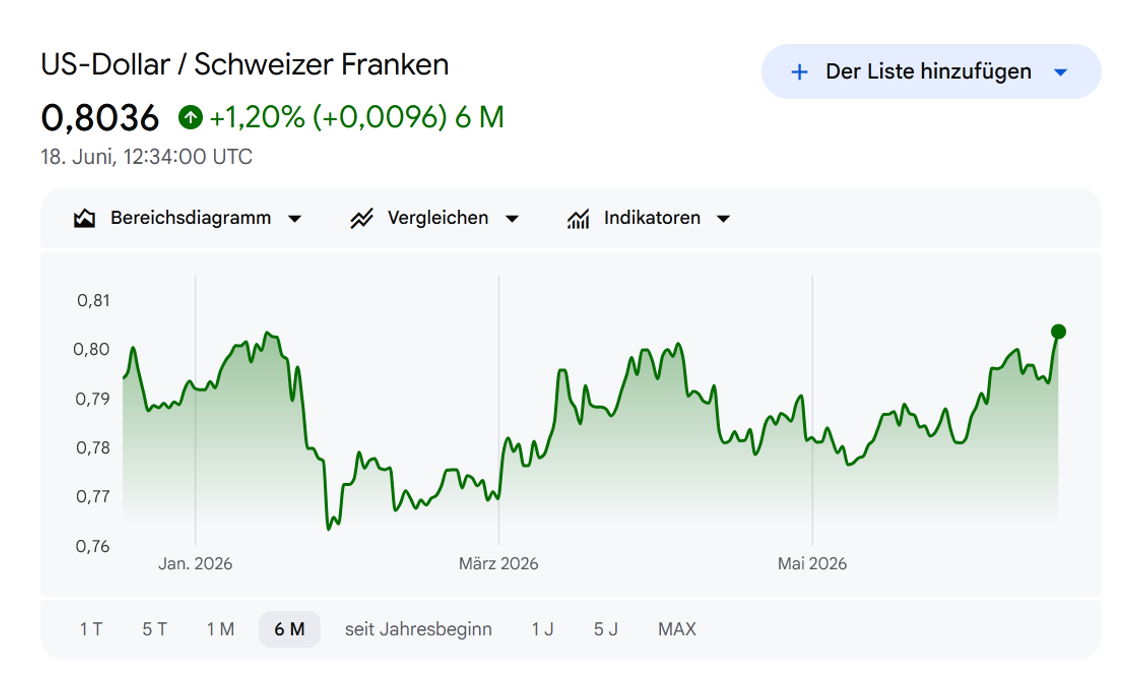
Viewed over the last two months, the value of the Swiss franc tended to fall slightly against the US dollar after an appreciation phase in February; on the day of the SNB’s interest rate decision, the franc lost 0.5 percent compared with the previous day, so that one dollar cost 0.803 francs.
The reference interest rate for rents was lowered to 1.25 percent at the beginning of September 2025, a value that has since remained unchanged in the three-month assessments by the Federal Office for Housing, most recently on 1 June 2026. Tenants who pay rent that, according to the rental contract, is based on a reference interest rate of 1.5 percent or more can submit a request for a rent reduction to the landlord. The mortgage reference interest rate for rents reacts much more sluggishly than the policy rate and does not automatically follow it. The Federal Office for Housing will announce the reference interest rate next on 1 September 2026.
Mortgage interest rates have tended to rise slightly over a period of one year. In June 2025, the average interest paid for a five-year fixed-rate mortgage was 1.31 percent. After reaching a high of around 1.68 percent in mid-May, however, they fell again to currently 1.56 percent.
If you financed your home with a SARON mortgage, little changes, because SARON is linked to the policy rate. A SARON mortgage currently costs at least 0.78 percent as of 18 June 2026 (-0.04 percent* plus a margin of 0.8 to 1.3 percent, which depends on the customer’s creditworthiness).
If you financed your residential property with a fixed-rate mortgage or would like to finance your real estate purchase with a fixed-rate mortgage, hardly anything changes either. Mortgage interest rates already fell significantly in 2024 and, after a brief rise in the first quarter of 2025, are once again comparatively low.
Low interest rates open up plenty of room for manoeuvre when financing a house or an apartment. Real estate prices remain high because of immigration pressure, limited land and the scarce supply of available housing. The rejection of the so-called 10-million initiative in Switzerland in June also contributes to the fact that housing in Switzerland remains in uninterrupted demand.
The costs of real estate are likely to continue rising, while mortgage interest costs are more likely to move sideways. A five-year fixed-rate mortgage is currently available from the cheapest provider from as little as 1.11 percent.
From a financing perspective, the favourable interest rate environment continues to make taking out a mortgage attractive for homeowners and buyers. As has historically been the case, a SARON mortgage is usually cheaper than a fixed-rate mortgage. The period between October 2023 and December 2024 was an exception.
*Indicative interest rates on 18 June 2026 at 2 p.m. UBS key4 mortgages determined these interest rates based on the following parameters: Canton of Zurich, loan amount CHF 500,000, affordability 20 percent, loan-to-value ratio 50 percent, payout date 19 June 2026. These interest rates are not a binding financing offer.

The SARON reference interest rate is directly linked to the policy rate and can fluctuate. SARON mortgages are therefore suitable for homeowners who can live with interest rate fluctuations and have a certain amount of financial leeway. A fixed-rate mortgage, on the other hand, is less exposed to fluctuations. It is recommended for homeowners who value a high degree of security and want to budget precisely over the long term.
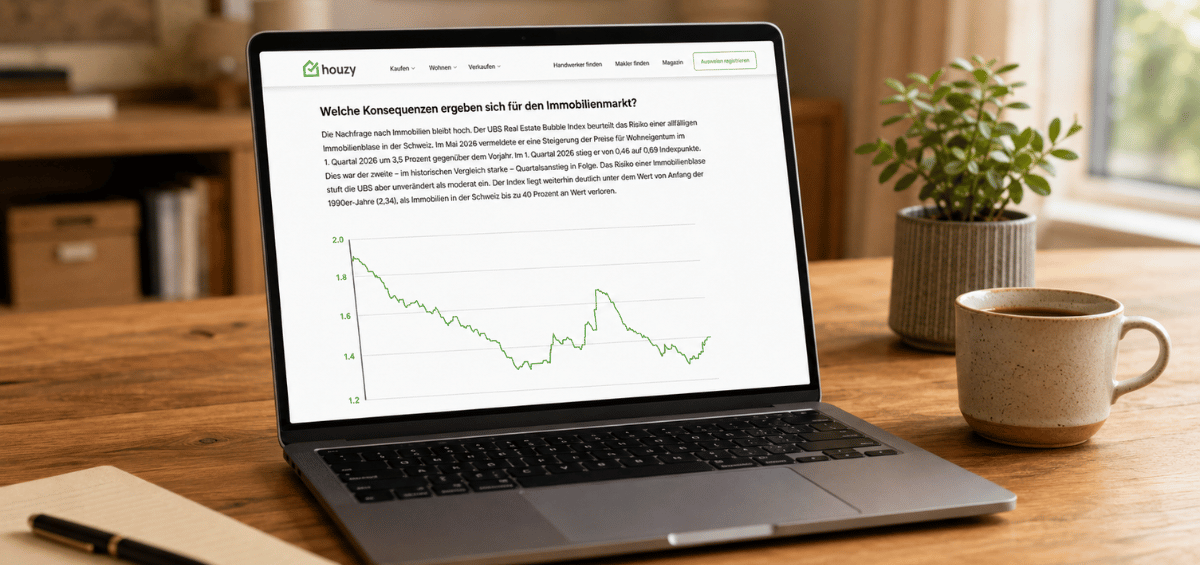
Demand for real estate remains high. The UBS Real Estate Bubble Index assesses the risk of a possible real estate bubble in Switzerland. In May 2026, it reported an increase in prices for residential property in the 1st quarter of 2026 of 3.5 percent compared with the previous year. In the 1st quarter of 2026, it rose from 0.46 to 0.69 index points. This was the second quarterly increase in a row that was strong by historical standards. However, UBS continues to classify the risk of a real estate bubble as moderate. The index remains well below the value of the early 1990s, 2.34, when real estate in Switzerland lost up to 40 percent in value.
For the next few quarters, UBS expects a slowdown in price increases for owner-occupied homes despite attractive financing conditions. Economic growth in Switzerland threatens to lose further momentum, and increasing uncertainty regarding jobs and incomes is likely to have a negative impact on demand for owner-occupied homes. “For the years 2026 and 2027, as a result of the strained affordability of residential property, we expect a slight weakening of price increases to around 3 percent.”
UBS experts continue to regard Switzerland as very competitive, meaning that the economy and population will continue to grow strongly over the long term. This also tends to make real estate prices more expensive. In the short and medium term, however, strong price increases are not to be expected. There is currently also no risk of a real estate bubble in Switzerland.
In its own real estate forecast from April 2026, Zürcher Kantonalbank ZKB expects 45,000 newly built apartments in Switzerland for 2026. In 2024 and 2025, around 40,000 apartments were built in each year. At the same time, the bank expects prices for residential property to rise by 3.5 percent, which represents a slight weakening compared with 4.9 percent in the previous year. This is based on a reference interest rate of 1.25 percent, unchanged from 2025.
As explained above, most market participants expected the announced zero-interest-rate round by the SNB.
Petra Tschudin, member of the Governing Board of the Swiss National Bank, assessed the economic outlook for Switzerland on 18 June: “In view of the conflict in the Middle East, economic development in Switzerland proved resilient. Gross domestic product (GDP) grew solidly in the first quarter.” According to the SNB, economic growth was supported by manufacturing industry, and services and construction also contributed to growth. Despite an overall positive development, unemployment has risen somewhat since the last monetary policy assessment. “In the coming quarters, the more moderate development of the global economy is likely to dampen growth in Switzerland, while our monetary policy will have a supportive effect. In the medium term, the expected improvement in the international economy will provide growth momentum.”
For the full year 2026, the SNB currently expects growth of around 1 percent; for 2027, it expects around 1.5 percent. The SNB considers developments in the global economy to be the main risk to the economic outlook in Switzerland. “In particular, the situation in the Middle East could escalate again and slow global economic activity more strongly. Upward pressure on the franc could also increase again. In addition, US trade policy remains an uncertainty factor.” Martin Schlegel added: “With the widening of interest rate differentials with other countries, the franc has lost some value. However, the geopolitical situation remains uncertain. The risk of strong upward pressure therefore remains. If necessary, our willingness to intervene in the foreign exchange market is therefore increased.”
Forecasts for future mortgage interest rate developments are always subject to uncertainty. After the surprisingly sharp reduction in the SNB policy rate in December 2024, interest rates are likely to move sideways, as they have for more than a year now, and remain stable at a low level. The monetary policymakers will publish the next monetary policy assessment in September 2026.
Our mortgage interest rate forecast until the end of 2026:
*Indicative interest rates on 18 June 2026 at 2 p.m. UBS key4 mortgages determined these interest rates based on the following parameters: Canton of Zurich, loan amount CHF 500,000, affordability 20 percent, loan-to-value ratio 50 percent, payout date 19 June 2026. These interest rates do not constitute a binding financing offer.
Long-term studies show: In the past, money market mortgages such as the SARON mortgage were cheaper than fixed-rate mortgages. From October or November 2023 to January 2025, however, short- and long-term mortgages were cheaper than a SARON mortgage. This exceptional phase ended in January of this year.
Mortgage conditions remain attractive. The time remains attractive to finance a single-family home or a condominium over the long term at favourable conditions. A look at the historical development of mortgage interest rates suggests that it may currently be worthwhile to consider a fixed-rate mortgage with a longer term of 5 or 10 years for the financing of residential property.
When deciding on specific mortgage models, it is always advisable to take your own family and financial situation into account and to seek advice from a specialist – for example from our real estate experts. Our rent-to-buy model can also represent an exciting alternative: with the smart rent-to-buy model, you can make your dream of owning your own home come true today, even if you only bring 10 percent equity.
Attention: Due to the abolition of imputed rental value in Switzerland no earlier than 2028, the ideal financing strategy can change significantly on an individual basis. We recommend that you address financing and renovation issues relating to residential property quickly. Also read our blog post on the abolition of imputed rental value.
Homeowners should sensibly not put everything on one mortgage. It is better to spread the financing across different mortgage models and terms. This allows you to diversify your interest rate risk and minimise the risk of having to renew the entire amount at the most unfavourable moment, for example in a high-interest-rate phase. UBS key4 mortgages recommends this mix:
The UBS Real Estate Bubble Index assesses the current situation for homeowners willing to sell as promising: for 2026, UBS expects a price increase of 3 percent for owner-occupied homes. If you are planning to sell residential property, now is a good time. Ideally, use, for example, our free sale price consultation or our estate agent recommendations for this. Our real estate experts advise you independently and recommend estate agents who know the real estate market in your region in depth and who can competently accompany you through the sales process at any time.
How you finance or refinance your residential property depends on many more factors than just the current interest rate. Your personal and financial situation, future plans, risk capacity and assessment of mortgage interest rate development play at least as important a role in choosing the right mortgage model and the right terms. Last but not least, when evaluating the right financing for your residential property, you should definitely include the effects of the abolition of imputed rental value.
Seek advice from a specialist and compare offers, services and prices. The offer that appears cheapest at first glance is not always the best one for you.
Would you like to buy residential property or is your mortgage due to be replaced soon? Compare mortgage models, terms and interest rates with our mortgage comparison and combine the most attractive offers flexibly. For example, a fixed-rate mortgage with an insurance company and a SARON mortgage with a bank. This allows you to benefit from the best conditions on the mortgage market and save a lot of money.