Building Alert Pro – All current building applications in your area at a glance
Discover building applications now


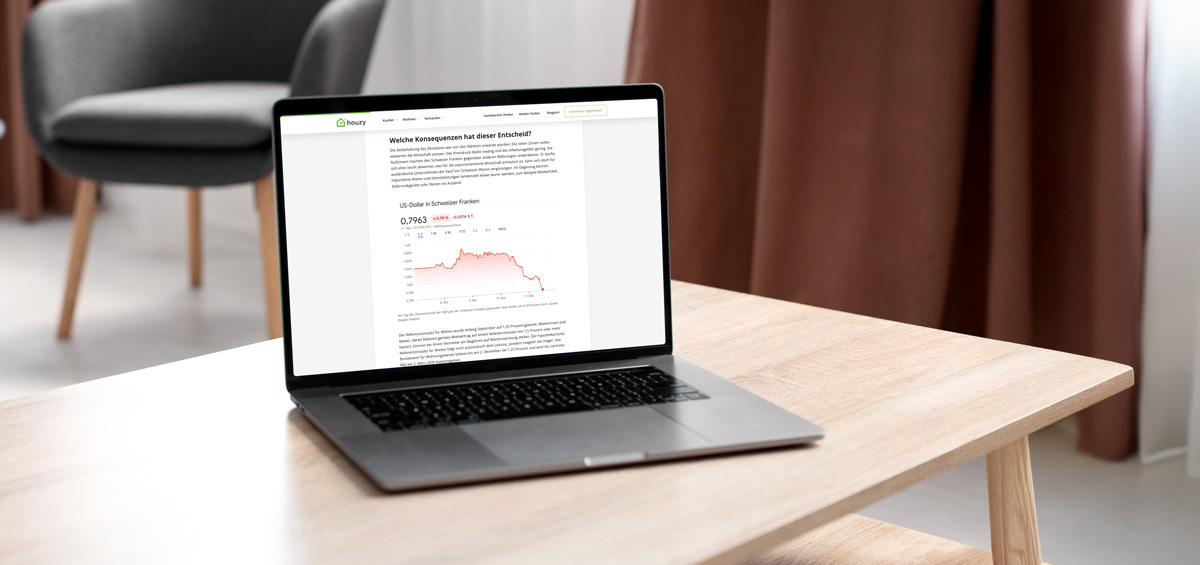
The Swiss National Bank (SNB) has announced for the second time in a row that it will maintain its policy rate. As a result, the rate has remained unchanged at 0.0 percent since June 2025.
This move was expected by most experts. As usual, the news agency Reuters surveyed economists ahead of the decision. Only 2 out of 40 experts expected a cut to -0.25 percent. By contrast, 38 of the 40 respondents — or 95 percent — predicted the zero-rate decision now communicated by the SNB. Market expectations were therefore met, meaning that little is likely to change in the Swiss mortgage interest rate market in the first quarter of 2026 compared with the current situation.
“Inflation has been slightly lower than expected in recent months. In the medium term, however, inflationary pressure is practically unchanged compared to the last assessment,” the SNB stated under its president Martin Schlegel.
Compared with the previous quarter, inflationary pressure has barely changed. For 2025, the SNB expects inflation of just 0.2 percent. For 2026, its forecast is slightly higher at an annual average of 0.3 percent, and 0.6 percent for 2027. “The forecast is based on the assumption that the SNB policy rate will remain at 0 percent throughout the entire forecast period,” the National Bank writes.
The global economy grew more strongly than expected in the third quarter, and uncertainty has decreased slightly compared to the last assessment. “In Switzerland, gross domestic product (GDP) contracted in the third quarter. This decline was primarily due to the pharmaceutical industry.” Overall, the SNB does not expect major disruptions in the medium term and therefore saw no reason to intervene more strongly in monetary policy.
After six consecutive rate cuts, this is now already the second monetary policy assessment in which the SNB has kept the policy rate at 0 percent.
One of the SNB’s most important tasks as Switzerland’s central bank is to ensure price stability. Its monetary policy aims to preserve the value of money for households and businesses in Switzerland and to support the development of the Swiss economy.
Inflation has declined slightly since the SNB’s last assessment, falling from 0.2 percent in August to 0.0 percent in November. This decline is primarily due to lower price increases in the hotel industry, rents, and clothing.
In the medium term, the new inflation forecast has changed little compared with the September forecast. Inflation remains within the targeted range for price stability — between 0 and 2 percent. For the full year, the SNB expects inflation of just 0.2 percent, and a slightly higher 0.3 percent for 2026.
The SNB continues to view US tariffs and trade policy uncertainty as burdens on the global economy. However, it notes positively that many economies have proven more resilient than expected. Inflation remained elevated in the United States, while in the euro area it hovered close to the target level.
Because inflation forecasts remain within the target range and economic prospects have hardly changed, the SNB currently sees no reason to adjust interest rates.
The decision to keep interest rates unchanged was expected by the markets. Low interest rates are intended to continue supporting the economy. Price pressure remains low and the risk of inflation is minimal.
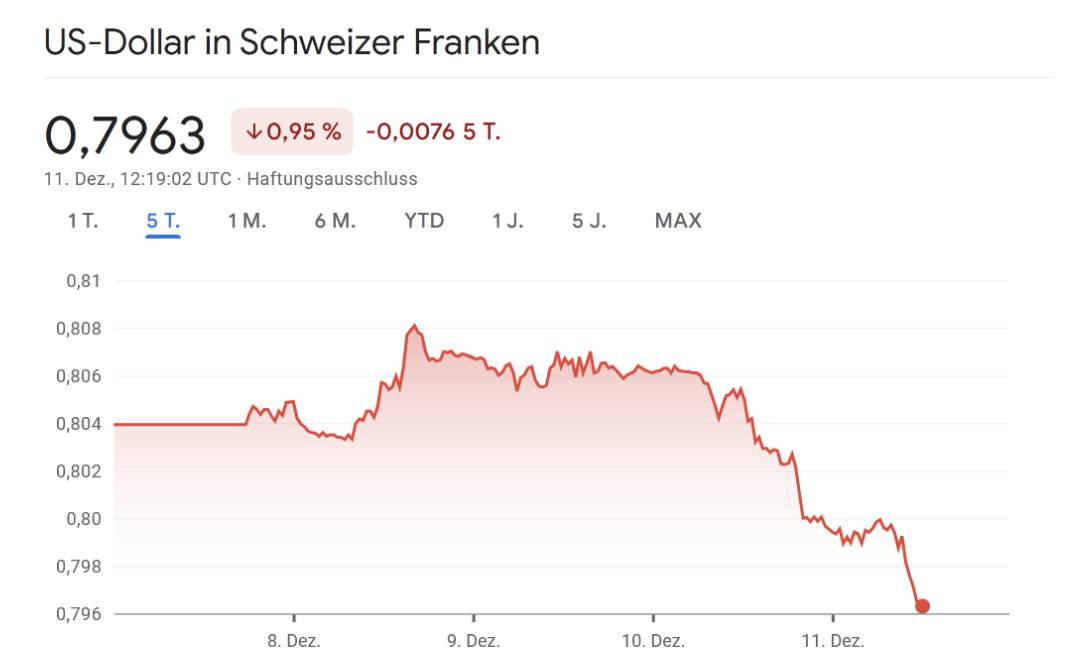
Zero interest rates make the Swiss franc less attractive compared to other currencies. It is therefore likely to depreciate slightly, which benefits export-oriented industries, as Swiss goods become cheaper for foreign buyers. On the other hand, imported goods and services may become somewhat more expensive, such as fashion items, electronic devices, or travel abroad.
The reference interest rate for rents was lowered to 1.25 percent at the beginning of September. Tenants whose rent is based on a reference rate of 1.5 percent or higher may request a rent reduction from their landlord. The mortgage reference rate for rents does not automatically follow the policy rate and reacts much more slowly. The Federal Office for Housing kept it unchanged at 1.25 percent on December 2 and will announce it again on March 2, 2026.
Mortgage interest rates have barely changed over the past six months. In Switzerland, they currently stand at around 1.44 percent for a five-year fixed-rate mortgage. This year’s peak was reached in March at about 1.72 percent.
If you have financed your home with a SARON mortgage, little will change, as SARON is linked to the policy rate. At key4, the margin for a SARON mortgage currently starts at 0.86% + SARON. The effective interest rate therefore consists of the SARON reference rate plus this margin. These figures are indicative and updated regularly.
If you have financed your home with a fixed-rate mortgage or are planning to do so, little is also likely to change. Mortgage rates already fell significantly in 2024 and are now very low again after a brief increase in the first quarter of 2025.
{{mortgage}}
Low interest rates continue to offer attractive financing options for purchasing a house or apartment. Property prices remain high due to immigration pressure, limited land availability, and a shortage of vacant housing. They are likely to continue rising slightly, while mortgage interest costs move sideways at a very low level. Currently, fixed-rate mortgage interest rates average just 1.73 percent across all providers and maturities, and as low as 1.37 percent with the cheapest provider.
From a financing perspective, taking out a mortgage can therefore still be recommended. As is historically typical, SARON mortgages are usually cheaper than fixed-rate mortgages. An exception was the period between October 2023 and December 2024.
Indicative interest rates as of December 11, 2025, at 12:00 noon. Rates calculated by UBS key4 mortgages based on the following parameters: Canton of Zurich, loan amount CHF 500,000, affordability 24 percent, loan-to-value ratio 50 percent, payout date December 12, 2025. These rates do not constitute a binding financing offer.
Demand for real estate is unlikely to change significantly at its current high level. The UBS Real Estate Bubble Index assesses the risk of a potential real estate bubble in Switzerland. According to the index, owner-occupied home prices rose by 0.8 percent in the third quarter of 2025 compared with the previous quarter — slightly less strongly than in the first half of the year. Compared with the previous year, owner-occupied homes became 3.5 percent more expensive — the highest increase in more than three years.
Accordingly, the UBS Swiss Real Estate Bubble Index rose moderately from 0.20 to 0.29 index points in the third quarter of 2025. This remains well below the level of the early 1990s (2.34), when property values in Switzerland fell by up to 40 percent.
The UBS Real Estate Bubble Index continues to classify the risk of a real estate bubble as “moderate.” UBS considers a downward price correction for owner-occupied housing to be unlikely, particularly due to expected population and economic growth.
For 2026, UBS expects a slight slowdown in price growth to around 3 percent nationwide. Rising uncertainty regarding jobs, incomes, and affordability is likely to weigh somewhat on demand.
Experts see no nationwide risk of overheating in the real estate market. As a result of economic and population growth, property prices are likely to continue rising, but not at a worrying pace.
According to Raiffeisen Chief Economist Fredy Hasenmaile, historically low interest rates continue to make property purchases attractive despite high prices. The SNB’s zero-interest policy has hardly any impact on mortgage conditions — neither for SARON nor for fixed-rate mortgages. Interest rate markets had already priced in this step and expect no further changes for at least one year.
As outlined above, most market participants expected the announced zero-rate decision.
In its media briefing on December 11, 2025, the SNB assessed inflationary pressure as still low. “In the short term, our conditional inflation forecast is slightly lower than in September, but in the medium term it is only marginally changed.” Uncertainty has decreased somewhat compared with the previous assessment.
Petra Tschudin, a member of the SNB’s Governing Board, stated: “The economic outlook for Switzerland has improved slightly due to lower US tariffs and somewhat better international developments. For the full year 2025, we expect GDP growth of just under 1.5 percent. For 2026, we expect growth of around 1 percent. In this environment, unemployment is likely to rise slightly.”
The SNB identifies global economic developments as the main risk to Switzerland’s economic outlook. International crises and trade policy uncertainty make clear forecasts for mortgage interest rate developments difficult. After the sharp drop following the unexpected rate cut in December 2024, mortgage rates are now likely to remain stable at low levels or decline moderately. The next monetary policy assessment will be published in March 2026.
Mortgage rate forecast through the end of 2026:
*Indicative rates as of December 11, 2025, at 2:00 p.m. Calculated by UBS key4 mortgages based on defined parameters. No binding financing offer.
Long-term studies show that money market mortgages such as SARON mortgages have historically been cheaper than fixed-rate mortgages. However, from October/November 2023 to January 2025, short- and long-term fixed-rate mortgages were cheaper — an exceptional phase that ended in January 2025.
Mortgage interest rates in Switzerland changed little in the third quarter of 2025 and remain close to the annual low recorded at the end of 2024. Most market participants continue to expect slightly falling or stable mortgage rates at low levels in 2026.
Conditions are currently attractive. For many, now is a good time to finance a home or apartment at favorable long-term conditions. A look at historical developments suggests that longer fixed-rate mortgages of 5 or 10 years may currently be worthwhile.
When choosing mortgage models, it is always advisable to consider your personal and financial situation and seek professional advice.
Homeowners should avoid relying on a single mortgage. Instead, financing should be spread across different mortgage models and maturities to diversify interest rate risk.
UBS key4 mortgages recommends the following mix:
According to the UBS Real Estate Bubble Index, conditions for sellers remain very favorable. UBS expects property prices to rise by 3 percent in 2026. If you are planning to sell, now is a good time.
How you finance or refinance your home depends on many factors beyond interest rates alone. Personal circumstances, future plans, risk tolerance, and expectations regarding interest rates all play a crucial role. Professional advice and careful comparison are strongly recommended.