Building Alert Pro – All current building applications in your area at a glance
Discover building applications now


%20(1).png)
For the first time this year, the Swiss National Bank (SNB) has announced the SNB policy rate. For the third time in a row, it has left it unchanged: since June 2025, it has stood at 0.0 percent.
With this, the SNB, under its President Martin Schlegel, continues to focus on continuity at a time when the international political and economic situation is worrying many people. As usual, the news agency Reuters had surveyed economists for their assessment in advance. Their verdict was clear: almost all of the 29 respondents assumed that the National Bank would leave the policy rate at zero percent. 28 of them even expect that the policy rate will not change throughout the entire year of 2026.
The National Bank explicitly addresses the international situation: "In view of the conflict in the Middle East, the National Bank's readiness to intervene in the foreign exchange market is increased." In doing so, it aims to counteract a rapid and excessive appreciation of the franc, which would jeopardize price stability in Switzerland. With a slight increase in inflation from 0.0 percent in November last year to 0.1 percent in February and the rise in energy prices due to the war in the Middle East, inflation is expected to rise in the coming quarters. In the longer term, however, the SNB continues to forecast inflation at a low 0.5 percent for 2026, 0.5 percent for 2027, and 0.6 percent for 2028. This means that inflation remains within the range of price stability as sought by the National Bank. It stated: "The medium-term inflationary pressure has hardly changed since the last assessment."
After six consecutive cuts, this is now the third geopolitical assessment in which the SNB has held firm to a policy rate of 0 percent.
It is one of the core tasks of the SNB as Switzerland's central bank to ensure price stability in the country. With its monetary policy, it pursues the goal of preserving the value of money for people and companies in Switzerland and supporting the development of the domestic economy.
Inflation has risen slightly since the SNB's last assessment, as expected, from 0.0 percent in November to 0.1 percent in February. Higher commodity inflation in particular contributed to this increase.
The SNB assesses the outlook for the global economy as difficult to predict, particularly due to the war in the Middle East. It stated: "Energy prices could rise more sharply than expected in the baseline scenario, which would significantly increase inflation and noticeably slow down economic growth. Possible supply chain problems and increased uncertainty could also weigh on growth. In addition to the situation in the Middle East, the trade policy outlook also remains uncertain."
In Switzerland, gross domestic product (GDP) grew again in the fourth quarter after a decline in the previous quarter. The National Bank identifies the global economy as the main risk for Switzerland's economic outlook, precisely because of the unclear situation in the Middle East. Nevertheless, the currency guardians remain positive and expect growth of 1 percent for 2026 and even 1.5 percent for 2027.
Martin Schlegel told the media: "Our conditional inflation forecast for the coming quarters is higher than in December due to the rise in energy prices. However, medium-term inflationary pressure has hardly changed since the last assessment." Thus, the SNB continues to see no reason to adjust the interest rate screw.
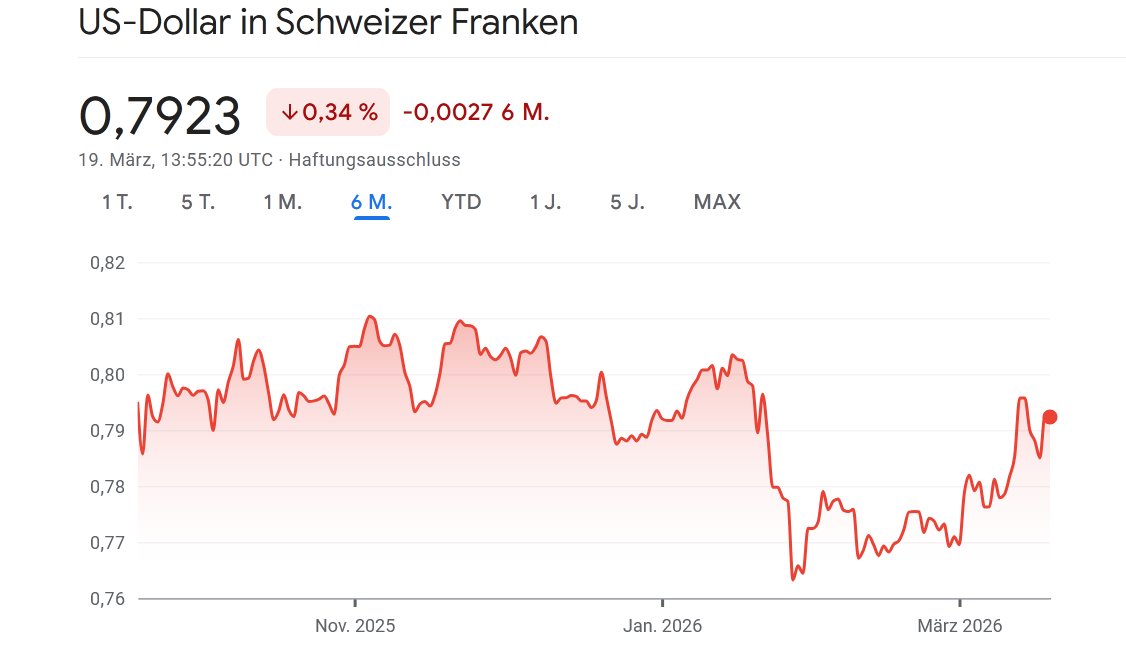
The markets had expected the zero-interest decision. The low interest rates are intended to continue supporting the economy. Price pressure remains low, and the risk of inflation is slight. In uncertain times, however, "the franc is sought after as a safe haven," as Martin Schlegel explained. "With the escalation in the Middle East, the appreciation pressure has increased again. On a trade-weighted basis, the franc has gained around 2.5 percent in value since mid-December."
The difference between the significantly lower interest rates in Switzerland compared to interest rates abroad is intended to continue making investments in francs less attractive and counteract the appreciation pressure. A zero-interest policy supports the export-oriented economy by ensuring that the purchase of Swiss goods remains attractive for foreign companies. Imported goods and services, on the other hand, tend to become more expensive with a weaker franc—for example, fashion items, electronic devices, or travel abroad.
The reference interest rate for rents was lowered to 1.25 percent at the beginning of September 2025, a value that remained unchanged at the next two assessments by the Federal Office of Housing at the beginning of December and on March 2, 2026. Tenants whose rent is based on a reference interest rate of 1.5 percent or more can submit a request for a rent reduction to their landlord. The mortgage reference interest rate for rents does not automatically follow the key interest rate but reacts much more sluggishly. The Federal Office of Housing will announce the next currently valid reference interest rate on June 1, 2026.
For a year now, mortgage interest rates have hardly changed. In Switzerland, they currently stand at approximately 1.5 percent for a five-year fixed-rate mortgage. The peak in 2025 was in March at around 1.72 percent.
If you have financed your home with a SARON mortgage, little will change, because the SARON is linked to the key interest rate. A SARON mortgage currently costs (as of March 19, 2026) at least 0.78 percent (-0.05 percent plus a margin of 0.8 to 1.3 percent, which depends on the customer's creditworthiness).
If you have financed your residential property with a fixed-rate mortgage or wish to finance your real estate purchase with a fixed-rate mortgage, little is likely to change. Mortgage rates already fell significantly in 2024 and are now very low again after a short rise in the first quarter of 2025.
{{mortgage}}
The low interest rates continue to open up attractive financing options when buying a house or an apartment. Real estate prices remain high due to immigration pressure, limited land, and the scarce supply of available living space. They are likely to continue rising, while mortgage interest costs move sideways at a very low level. Currently, the interest rates for a fixed-rate mortgage average only 1.65 percent across all providers and terms; a five-year fixed-rate mortgage is already available from the lowest provider for 1.16 percent.
The favorable interest rate environment continues to make it attractive for homeowners and buyers to take out a mortgage from a financing perspective. As is historically common, a SARON mortgage is usually cheaper than a fixed-rate mortgage. An exception was the period between October 2023 and December 2024.
Tip: The SARON reference interest rate is directly linked to the key interest rate and can fluctuate. Therefore, SARON mortgages are suitable for homeowners who can live with interest rate fluctuations and have a certain financial cushion. A fixed-rate mortgage, on the other hand, is exposed to fewer fluctuations. It is recommended for homeowners who value high security and want to budget precisely over the long term.
Demand for real estate remains unbreakably high. The UBS Real Estate Bubble Index assesses the risk of a potential real estate bubble in Switzerland. It noted in February 2026 that owner-occupied homes became 4.1 percent more expensive compared to the previous year—a further increase compared to the previous quarter with its previous peak of 3.5 percent.
The index rose again in the 4th quarter of 2025, specifically from 0.27 to 0.48 index points—the strongest quarterly increase since 1989. Nevertheless, it remains significantly below the value of the early 1990s (2.34), when real estate in Switzerland lost up to 40 percent of its value.
The UBS Real Estate Bubble Index classifies the risk of a real estate bubble unchanged as "moderate." UBS considers a downward price correction for residential property to be unlikely, particularly because of the expected growth in population and the economy.
For 2026, UBS expects a slight weakening of the price increase to around 3 percent for owner-occupied homes on a national average. Increasing uncertainty regarding jobs, income, and the strained affordability of residential property is likely to have a rather negative effect on the demand for owner-occupied homes.
UBS experts see no risk of overheating in the real estate market nationwide. As a result of economic and population growth in Switzerland, real estate prices will continue to tend to become more expensive, but not to a worrying extent.
In its own real estate forecast from January 2026, Zürcher Kantonalbank (ZKB) expects 47,000 newly built apartments in Switzerland for the year 2026. In 2024 and 2025, around 40,000 apartments were built each year. Although the bank predicts both a decline in net immigration and the mentioned strong increase in residential construction activity, it simultaneously expects prices for residential property to rise again by 4.5 percent, as in 2025. This is with a reference interest rate of 1.25 percent, unchanged from 2025.
As explained above, most market participants expected the announced zero-interest round.
Currently high oil prices are having a dampening effect on global economic growth. This development is already partially reflected in the tight labor market. Petra Tschudin, member of the Governing Board of the Swiss National Bank, commented: "In Switzerland, gross domestic product (GDP) grew again in the fourth quarter after having declined in the previous quarter. The reason for this is that value added in the pharmaceutical industry rose again after the significant decline in the third quarter. The services continued to expand. Unemployment stabilized and in February was at the same level as at the time of the last assessment."
The economic outlook for the coming months, however, is assessed by the SNB as uncertain, particularly due to the armed conflicts in the Middle East. Martin Schlegel said: "With the appreciation of the franc, monetary conditions have become tighter compared to the assessment in December. The appreciation reduces imported inflation and dampens economic development." Uncertainty is currently significantly increased. The SNB is therefore showing a greater willingness to intervene in the foreign exchange market if the franc should continue to appreciate excessively and rapidly.
The globally uncertain situation makes it difficult to provide certain forecasts for future mortgage interest rate developments. Their big jump downwards occurred after the unexpectedly strong cut in the SNB key interest rate in December 2024. However, they are likely to move sideways, as they have for over a year now, and remain stable at a low level or decrease moderately. The currency guardians will publish the next assessment in June 2026.
Our mortgage interest rate forecast until the end of 2026:
Long-term studies show: In the past, money market mortgages like the SARON mortgage were cheaper than fixed-rate mortgages. However, from October or November 2023 to January 2025, short- and long-term mortgages were cheaper than a SARON mortgage. This exceptional phase ended in January of this year.
Mortgage interest rates in Switzerland hardly changed in the 4th quarter of 2025 and are close to the three-year low of mid-2025. Most market participants expect mortgage interest rates to continue to fall slightly or remain stable at a low level for 2026.
Attractive mortgage conditions currently prevail. For many, now is likely a good time to finance their own home or condominium long-term at favorable conditions. A look at the historical development of mortgage interest rates suggests that it can currently be worthwhile to consider a fixed-rate mortgage with a longer term of 5 or 10 years for the financing of residential property.
When deciding on specific mortgage models, it is always recommended to include your own family and financial situation and to seek advice from a specialist—for example, from our real estate experts. Our rent-to-buy model can also represent an exciting alternative: with the smart Rent-to-buy model, you can fulfill the dream of your own home today, even if you only bring 10 percent equity.
Ideally, homeowners do not put everything on one mortgage. It is better to spread the financing across different mortgage models and terms. In this way, you spread your interest rate risk and minimize the danger of having to renew the entire sum at the most unfavorable moment, for example, during a high-interest phase. UBS key4 mortgages recommends this mix:
The UBS Real Estate Bubble Index assesses the current situation for homeowners wishing to sell as very comfortable: For 2026, UBS expects a price increase of 3 percent for owner-occupied homes. So, if you are planning to sell residential property, now is a good time.
How you finance or refinance your residential property depends on much more than just the current interest rate. Your personal and financial situation, future plans, risk capacity, and assessment of mortgage interest rate development play at least as important a role in the choice of the right mortgage model and the right terms. Seek advice from a specialist and compare offers, services, and prices. The cheapest offer at first glance is not always the best one for you.
Are you looking to buy residential property or is your mortgage due for renewal soon? Use our mortgage comparison to compare mortgage models, terms, and interest rates and flexibly combine the most attractive offers. For example, a fixed-rate mortgage with an insurance company and a SARON mortgage with a bank. This way, you benefit from the best conditions on the mortgage market and save a lot of money.