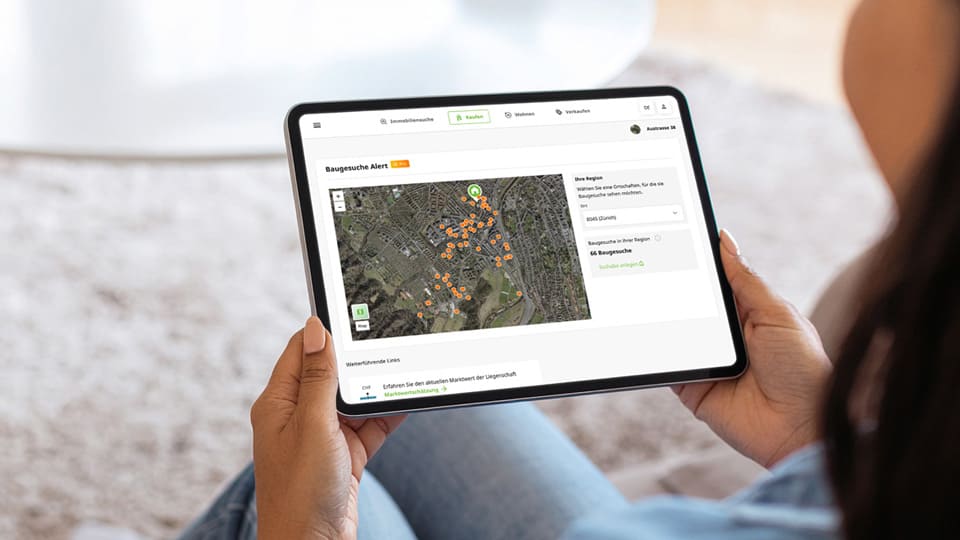
Building Alert Pro – All current building applications in your area at a glance
Discover building applications now


.png)
Anyone who builds not only changes buildings or other structures on their own property, but also affects the surrounding area. That's why, under certain conditions, neighbours and other affected parties have the right to object to a building permit application. But who is actually entitled to object? What deadlines apply? And how does the process work? Houzy explains what you need to know about objecting to a building permit application.
The builder submits a building permit application together with the complete dossier, including plans. This is generally assessed by the municipality where the construction project is planned. It checks whether the application is admissible, in particular whether all legal requirements have been met. Special attention is paid to the dimensions and key parameters of a structure:
Each municipality defines its various zones within its territory, for example core zone, W2 zone (maximum two full storeys), and many more. This municipal ordinance is named differently from canton to canton, for example building and zoning regulations, building and land-use regulations, building code and zoning plan, or building and zoning code. This ordinance in turn must comply with the superordinate law — the cantonal planning and building law.
For each zone, the building and zoning regulations set out how tall buildings may be and how many storeys they may have. They also define, for example, the ratio of residential to commercial use, the number of required parking spaces, and much more. The protection status of townscapes can also be defined for a zone, for instance with a ban on flat roofs or photovoltaic systems in sensitive core zones.
Once a person or company has submitted a building permit application to the municipality, the building authority reviews it. As soon as it deems the construction project legally compliant, it publishes it. This means the plans are made publicly available and published in the official gazette or on the municipality's website. A construction project is also marked out with building profiles (construction stakes). These indicate the location and dimensions of the project, allowing residents and neighbours to get an idea of the future building volume, both horizontally and vertically.
Directly affected parties can now object to this building permit application. The municipality only issues the final building permit once all objections have been legally and conclusively resolved.
{{building-permit}}
With a building objection, neighbours, associations or companies directly affected by a construction project can challenge the granting of a building permit and demand that the application be reviewed again, in part or in full. The purpose of an objection is generally not to prevent a construction project altogether, but to ensure that all legal requirements are met.
An objection can be raised, for example, if a project violates building regulations or affects protection-worthy interests of the neighbourhood.
Not everyone is entitled to submit an objection to a building permit application. As a rule, the following persons are entitled to object:
Typically, these are direct neighbours of adjoining properties. They do not necessarily have to be owners. Tenants can also be entitled to object, but must of course meet the conditions of spatial proximity to the project and personal impact.
Depending on the canton and the construction project, environmental or heritage protection associations may also be entitled to object under certain conditions.
An objection must always be submitted in writing, be factually justified, and relate to concrete, measurable circumstances. If you simply don't like the construction project, don't want your neighbour to have it, or don't get along with them — these are not valid grounds for an objection. Nor is it a valid reason that noise or access restrictions arise during the construction period. A certain degree of noise and other nuisance is always to be expected with a construction project.
Extortion in the sense of "I won't object to your project if you pay me a hundred thousand francs…" is not permitted and is punishable by law.
A building objection must relate to legally relevant aspects. Common grounds for objections include:
Whether the objection is successful is decided by the responsible building authority based on the applicable legal regulations.

The objection period begins with the public disclosure of the building permit application at the municipality. In many cantons, it is 20 or 30 days. It generally cannot be extended.
Which deadline applies is stated in the official publication of the building permit application and depends on cantonal building law. It is important to read the publication carefully. Anyone who misses the deadline loses their right to object.
What matters for a valid objection is that it is received, or submitted, on time in accordance with the cantonal regulations, to the responsible authority.
A building objection must be submitted in writing. It must contain at least the following information:
The more precise your justification, the easier it is for the authority to assess whether your objection is justified and whether it may require the builder to revise their project. An objection that serves solely to delay a construction project, or that is submitted without a relevant justification, is considered an abuse of process.
The process of an objection procedure is regulated differently from canton to canton. However, it usually follows a similar pattern.
If you or the builder are not satisfied with the authority's decision, the parties can appeal to the next higher instance. In some cantons, this legal authority is the cantonal building appeals court, an administrative court, or the government commissioner's office. Their decision, too, can be appealed to the next higher instance — depending on the canton, this may be the administrative court or the building directorate — and, as a final instance, the Federal Supreme Court.
Appeals delay both the building permit procedure and the construction project. However, every appeal also involves legal costs, and as a rule the losing party bears the court costs. This means that appeals across multiple instances can become very costly.
The cost of an objection varies depending on the canton, municipality, subject matter and complexity of the construction project, the course of the proceedings, and the court instance involved. Depending on the canton, you may have to pay procedural fees, which are usually in the range of a few hundred francs, though they can be significantly higher for complex proceedings.
If you wish to raise an objection, you should carefully assess whether it is legally well-founded. Consulting a legal professional is advisable, as a carefully substantiated objection can help avoid unnecessary costs. However, legal fees for this advice are generally your own responsibility. If you have taken out legal expenses insurance — before the start of any proceedings — it may cover certain costs. The applicable insurance terms are decisive here.
Depending on the outcome of the proceedings, you may be awarded compensation for costs. However, if your objection is dismissed, you risk being ordered, as the losing party, to bear both the procedural costs and compensation for the opposing party.
The further you wish to pursue a case, the more expensive it becomes, as the justifications for objections and appeals must be formulated more precisely at each further court level, referring each time to the preceding judgment.

Conclusion: It is not possible to give precise figures for the cost of an objection procedure. As a general rule, you should expect a few hundred francs in procedural fees at the first instance, plus a few hundred francs in legal fees depending on the effort involved. The first objection alone is therefore likely to cost around a thousand francs. Further costs strongly depend on the outcome of the proceedings — and on whether you or the opposing party take a judgment to the next instance.
Communication isn't everything, but everything is communication. Many objections arise because neighbours only learn about a construction project once it is publicly disclosed.
Builders can avoid conflicts by:
Open communication won't prevent every objection, but it can help avoid lengthy proceedings.
If you, as an affected party, disagree with your neighbour's construction project, we recommend: talk to them first. Explain factually and with concrete arguments why you disagree with their project and why you will object if it is built as presented to you. If you argue convincingly, they may incorporate your concerns before submitting the building application. Going the legal route is generally always more expensive than reaching an out-of-court agreement.
By the way: To be informed as early as possible about construction projects in your area and never miss a deadline, we recommend using Houzy Baugesuche Pro. Our tool notifies you automatically the moment a new building permit application is submitted.
{{building-permit}}
A building objection is a valuable tool for ensuring compliance with building law and protecting the legitimate interests of affected parties. At the same time, it does not automatically mean the end of a construction project. Many proceedings end with project adjustments or an amicable solution.
Always base an objection on solid grounds. Also keep in mind: if you pursue an objection solely to delay a construction project, you may gain some time — but the project will ultimately be realized anyway. Over this period, which can sometimes last several years, the legal dispute will continue to occupy you to a greater or lesser extent.